


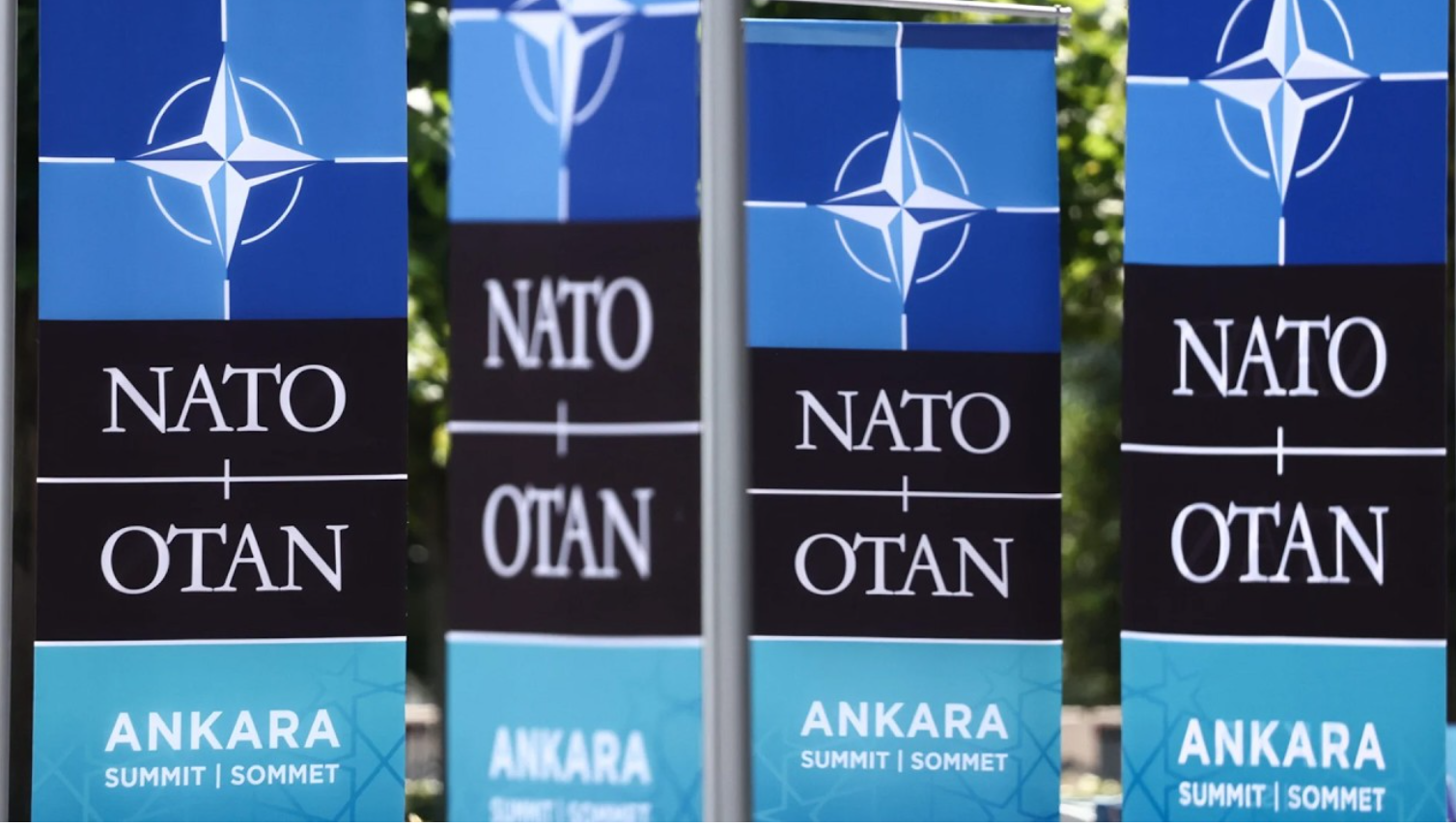


By Mark Anderson
Foreign Policy Beat
CHICAGO, Ill. — At a Chicago Council on Global Affairs-sponsored discussion on the
status and role of the North Atlantic Treaty Organization in the wake of the just-
concluded July 7-8 NATO summit in Ankara, Turkey—covered virtually in real time by
this reporter—the scenario of Israel conceivably attacking Turkey, which is a NATO
member, was discussed with a palpable sense of trepidation.
The core question is: What would NATO do if Israel were to attack Turkey, given the
alliance’s NATO Treaty/Article 5 commitment that an attack on one NATO member is an
attack on all? Doing nothing would likely seriously undermine NATO’s credibility as the
US withdraws some NATO funding and participation.
While some view Israel as an aggressor that committed what amounted to a genocide
against Gaza, others see it as the only democracy in the Middle East and a longtime US
ally. So, could NATO intervene if Israel moves against Turkey?
With the US having been in the military-leadership and financial driver’s seat of NATO
since its 1949 founding—while taking into account the US showering Israel with billions
in military aid annually, and standing for Israel under all circumstances—there evidently
are no solid answers to this “Israel question” forthcoming anytime soon.
For its discussion on this and other key topics coming out of the NATO Summit, the
Chicago Council on July 13 welcomed Julianne Smith, who’s the former US
Ambassador to NATO (and the Chicago Council’s Distinguished Nonresident Fellow for
Defense and Security); as well as Gen. Christopher Cavoli, who’s the 20th Supreme
Allied Commander for Europe and 19th Commander of the European Forces.
Chicago Council President and CEO Leslie Vinjamuri, formerly with the British-
establishment think tank, Chatham House, moderated the discussion.
Ms. Smith wondered “how the world would respond,” as she put it, if Israel were to
attack Turkey. She noted that, because NATO typically focuses on hostile ground
forces, especially those from Russia, breaching the borders of neighboring states and
ushering in a standoff or possible shooting match, the specter of an air attack by Israel
against Turkey appears to be outside NATO’s established frame of reference.
Ms. Smith said she believes Russian leader Vladimir Putin is trying to promote this
Israel scenario to undermine NATO’s credibility, while NATO is downplaying the issue.
She added that NATO members are not mandated to carry out a specific type of
response when a fellow NATO member(s) comes under attack, indicating they maintain
enough sovereignty to decide exactly how to respond.
Gen. Cavoli, whose interoperable U.S. command structures have been designed to
collaborate with Israel, indicated at the Chicago discussion that NATO rarely discusses
policy toward Israel, as it’s geographically outside the alliance’s operational scope.
More generally, NATO’s exclusion of Israel, which maintains strategic independence
anyway, theoretically helps keep NATO from being dragged into a Middle East quagmire
under Article 5. Yet, Turkey, whose location is like a bridge between Europe and Asia, is
seen as a Middle Eastern nation in some circles.
ISRAEL’S VIEW OF TURKEY
Various strategic discussions at the Chicago Council and beyond have taken into
account that Israel considers Turkey a “growing long-term threat” driven by Ankara’s
expanding military footprint, its defense manufacturing, and the scenario of Turkey filling
a void left by an allegedly declining Iran.
Turkey’s reported growing influence in northern Syria is also of concern to Israel,
according to Modern Diplomacy. The Israel Policy Forum adds that Israel is not friendly
with the new post-Assad Syrian government that Turkey supports—apparently a key
reason Israel might contemplate attacking Turkey.
Also, the Jerusalem Post reported that Turkey’s growing military footprint and its
acquisition of advanced weapon systems like the American F-35 threatens what’s
known as Israel’s “qualitative military edge.”
 valleyx0