




BY Mark Anderson | The Lansing News Wire
ROYAL OAK, Mich. — This year, Catholics and other Christian tourists across the nation are recognizing the centennial of the Royal Oak Parish and its National Shrine of the Little Flower Basilica, located near Detroit.
While the National Shrine’s leaders opened its doors at the corner of Woodard Avenue and 12 Mile Road for a general public tour on April 18, private tours can be arranged throughout the year.
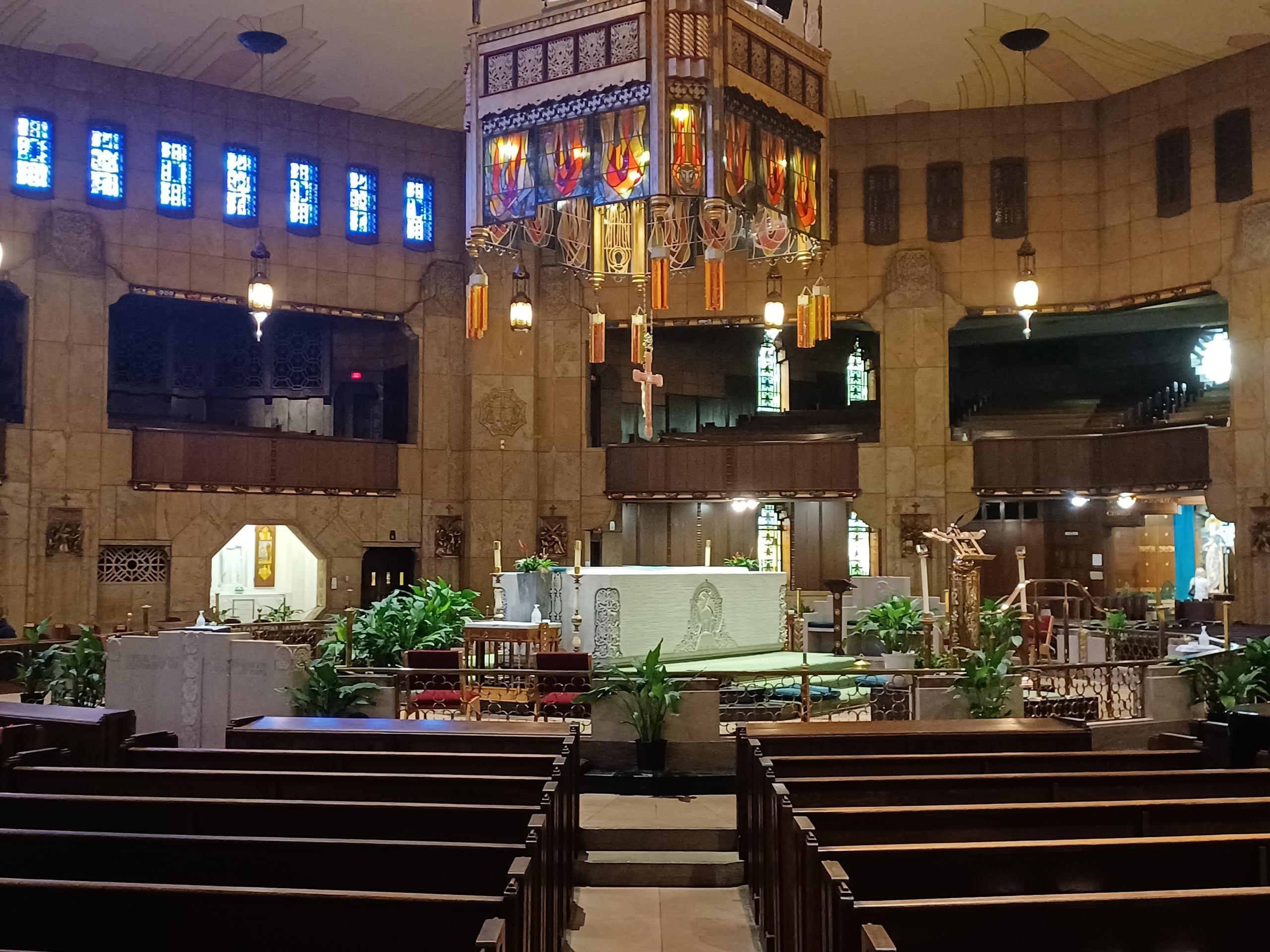
The Shrine, a magnificently designed art deco church that dons impressive art, has a unique octagonal nave and a 105-foot tower crafted of marble from the Italian Alps. The Shrine even has a marble stone from Calvary, located in the far-right corner of the St. Thérèse Chapel. It was gifted to the church by Pope Pius XI in the late 1930s.
This architectural wonder was conceived in the early 1930s by the noted “radio priest” Charles E. Coughlin. The Canadian-born cleric established the Royal Oak Parish itself 100 years ago in 1926—hence the Centennial observance. At the time, Father Coughlin launched the Parish by building the original modest Church of the Little Flower, which was destroyed by fire in March of 1936.
Construction of what eventually became today’s National Shrine began in 1931 and was finished in 1936, complete with Crucifixion Tower, which is now called Charity Tower.
Pope Francis designated this National Shrine as a Minor Basilica in 2014-2015. It is the first parish in the Archdiocese of Detroit to have received this honor. Notably, Father Coughlin broadcast his at-times controversial live radio sermons on biblical, political and economic topics from that very tower, on which is etched the images of several archangels.
Indeed, not everyone is aware of the National Shrine’s full significance.
“We have people that come and worship at the [National] Shrine that don’t know the story behind the art and the architecture and the symbolism in the church,” Judy Maten, chair of the Shrine’s Centennial Committee, was quoted as saying by the local Royal Oak Review. “It’s a beautiful worship space, but there’s so much more behind it.
Everything there is intentional, and it tells a story. I like to think that it’s the Gospel in stone.”
Maten raised her family through the National Shrine of the Little Flower Basilica and has also worked there.
“We have made great friendships there . . . . The entire celebration of the Centennial is an opportunity for us to give back to the community that [the] Shrine has been an anchor in,” Maten also was quoted as saying.
The book “Praying with St. Thérèse of Lisieux” was written by Maten and laid out by fellow parishioner Jeanine Twigg. It was written in celebration of the Parish’s 100th anniversary and reflects the spiritual life of St. Thérèse of Lisieux, whose short life of total devotion to God constitutes the meaning behind the National Shrine.
St. Thérèse died Sept. 30, 1897 at age 24 in the Lisieux Carmel convent in France. She died after a long struggle with TB. Despite intense pain and a spiritual “dark night” in her final days, she remained devoted, with her last words being “My God, I love You!”
From the young age of nine, St. Thérèse knew she was called to be a Carmelite nun. She was canonized a Saint on May 17, 1925.
 Raul Garcia